Posted on
There are many thin film applications that require a patterned coating, such as focal plane arrays with high-density pixels for LiDAR, video imaging and spectrometry. In such applications, a layer of photoresist material is placed on the surface of the wafer, masking the wafer so that only the desired areas are coated through the openings in the mask. Once the thin film has been deposited, the photoresist is then dissolved in a process known as “liftoff,” where the mask and the excess coating are removed, leaving the pattern.
Achieving proper liftoff is a tricky process. The film needs to be deposited cleanly and evenly across the wafer. The biggest factor affecting lift-off in magnetron sputtering is system geometry, in particular collimation control.
Collimation control is also increasingly important in coating complex 3D shapes and sidewall coverage for Through-Glass Vias (TGVs) and Through-Silicon Vias (TSVs) used in the 3D packaging for emerging AI and quantum computing applications.
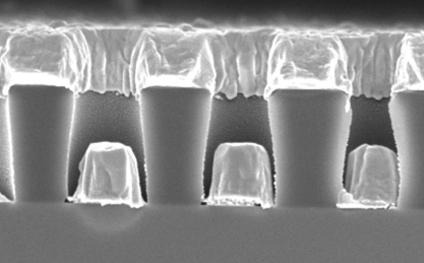
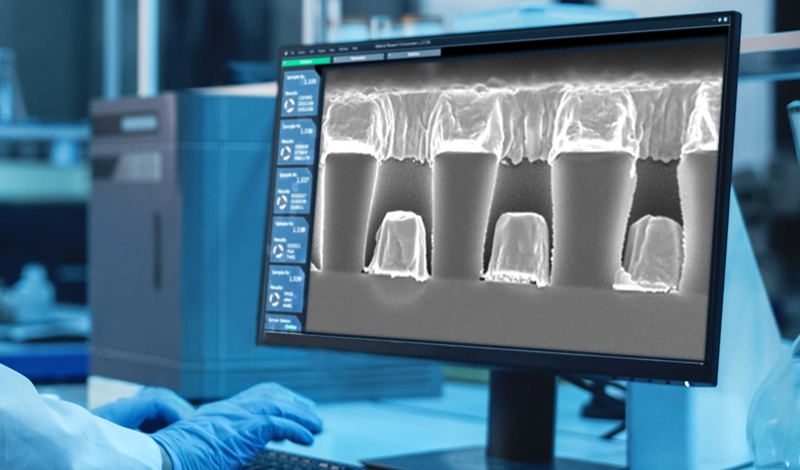
Figure 1. A photoresist mask for the deposition of indium bumps. Good collimation control ensures the material is deposited directly on the wafer and not on the sides of the photoresist mask, improving liftoff.
Collimation control is the key to proper liftoff
Poor collimation causes sidewall coverage, blocking solvent access to the photoresist and preventing resist removal, lowering yield. The material to be deposited needs to come straight into the Via and deposit only on the bottom, not on the sidewalls.
In a well-collimated beam, the path of all the atoms coming from the source are parallel and perpendicular to the wafer. For the best lift-off, the sputtering direction needs to be straight up. The angular distribution for Vias typically needs to be less than 7° from line of sight.
There are traditionally two ways to achieve proper collimation:
Long throw collimation. Increasing the distance from the ion source is one way to ensure proper collimation. As an analogy, the Earth is far enough away from the Sun that all the Sun’s light rays are parallel when they reach Earth. Closer to the Sun, the light rays are coming at multiple angles.
In thin film deposition, long throw collimation works best in low-pressure environments. As the air pressure increases, it becomes more likely that an atom will collide with another molecule and be deflected from a parallel trajectory.
Physical collimation. This approach uses a physical device to block ions with a high distribution angle – that is, that deviate from vertical. The analogy here would be a telescope. When looking through a telescope at something far away, all the light rays coming from the side are blocked, leaving only the rays coming straight at the telescope. Telescopes have lenses to magnify images, but even just looking through a paper towel tube improves visibility because of the physical collimation.
However, in thin film deposition physical collimators can be subject to significant buildup of high-angle material, and, because the collimator is generally placed within the magnetron plasma, can cause unacceptable levels of particle generation.
To overcome these problems and ensure proper liftoff, Denton offers Dual Collimation, a combination of long throw and physical collimation.
Dual Collimation uses an intermediate throw (between standard and long throw) together with a physical collimator. This Dual Collimation technique reduces the throw and places the collimator close to the wafer to achieve an acceptable collimation. This eliminates the need for operating at a very low pressure. It also reduces the build-up on the collimator and positions it out of the plasma so the collimator sees less heat, which minimizes particle generation.
Achieving high collimation for good lift-off will necessarily slow the deposition rate compared to standard throw sputtering, but it can also dramatically increase yield. In high-volume manufacturing, magnetron sputtering combined with Dual Collimation can still offer throughput advantages over evaporation.
For more information on Dual Collimation, check out our previous blog posts, 4 Design Considerations for Improving Lift-Off Yield, Considerations for Using Magnetron Sputtering for Lift-Off Applications, and Closure Rate and Uniformity in Indium Bump Deposition.