Posted on
Manufacturers are increasingly seeking to automate as much of the thin film deposition process as possible, working towards a complete “lights out” operation. As a result, manufacturers are moving away from evaporative physical vapor deposition (PVD) methods to using magnetron sputtering. Here’s why.
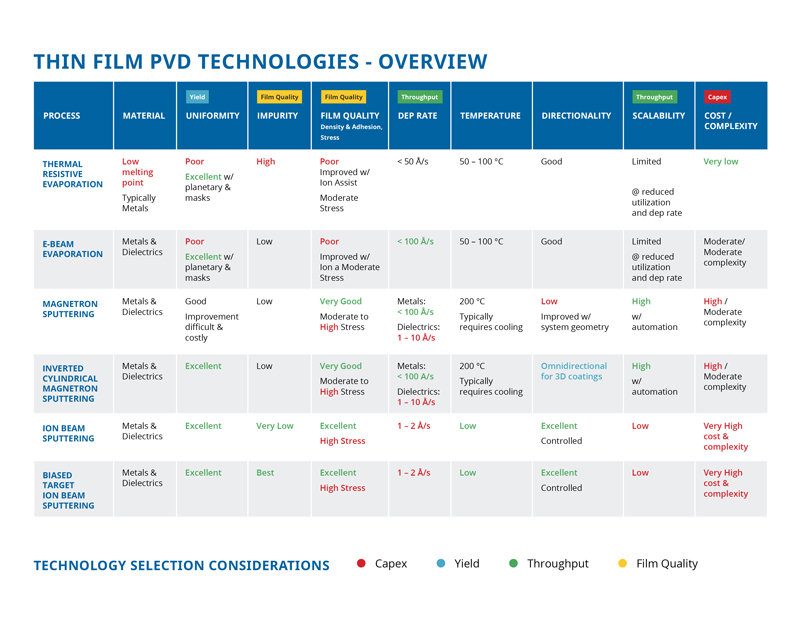
While both evaporation (by thermal resistance or e-beam) and sputtering (either magnetron or ion beam) have pros and cons that make one or the other better suited for particular applications, magnetron sputtering is the superior choice for highly automated, high-volume production.
The problems with automating evaporative PVD
Evaporative PVD relies on heating a solid source material past its vaporization temperature. This is done using either a resistive heat source or an electron beam to vaporize the material. Resistive thermal evaporation is one of the simplest, lowest-cost and most common forms of PVD. E-beam evaporation produces a very high temperature, vaporizing metals and dielectrics with high melting temperatures (such as gold and silicon dioxide). E-beam evaporation has the highest deposition rate of any PVD method.
Evaporation is typically used for applications such as optics or metal electrical contacts. It’s also easy to change materials and can be cost-effective for precious metals.
However, evaporation tools tend to be batch tools used with large domes or planetary substrate fixing, which cannot be loaded using robots and therefore require manual loading. There is also a limit to the amount of source material that can be handled by the evaporator. Evaporative PVD systems can often only handle one or two runs before the source material is exhausted and the system has to be vented and reloaded.
These two limitations make evaporative PVD processes poor candidates for automation. It can be done, in limited circumstances, but there is seldom much to be gained in automating evaporative PVD.
Why magnetron sputtering is the superior choice for automation
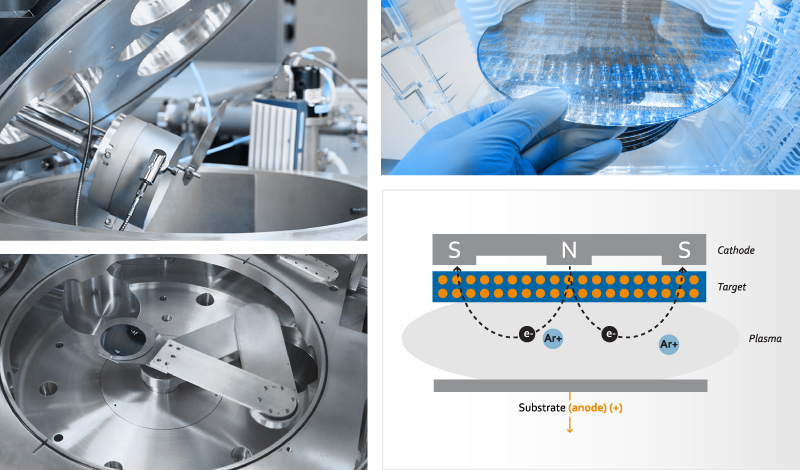
Magnetron sputtering is a plasma-based coating method, using positively charged energetic ions from a magnetically confined plasma aimed at a negatively charged target material, ejecting (or “sputtering”) atoms from the target that are then deposited onto a substrate. This closed magnetic field traps electrons and boosts efficiency—creating plasma at lower pressures and temperatures, reducing gas incorporation in the film and energy losses in the sputtered atom.
Magnetron sputtering creates high-quality, dense films with excellent adhesion and step coverage on complex 3D shapes and large area coatings. Sputtering is better suited for a wider range of materials, including alloys and insulators. Because the plasma and the target are always in the same place, magnetron sputtering also offers high repeatability. Using magnetron sputtering generally involves a higher capital expense, but it offers lower operating costs in high-throughput settings. Its inherent repeatability, flexibility, and ability to handle complexity make magnetron sputtering a good candidate for automation.
Compared to evaporative PVD, the sputtering target in a magnetron sputtering system can last for months, making it possible in some cases to operate the system for extended periods before the source material needs to be replenished. Combined with magnetron sputtering’s compatibility with robotic handling of the substrates, this makes it the ideal method for 24/7, lights out, automated continuous manufacturing processes.
Ion beam sputtering can also be automated, using a Denton Versa cluster, supporting a continuous process without breaking vacuum.
Choosing the right PVD process
Any thin film PVD process decision must weigh the right balance of system cost, yield, throughput and film quality. Automation is just one factor of many that must be considered, though it is of increasing importance in today’s market. If you need help making the right selection, contact us – we’re happy to guide you through the process.